Rosa's Prize
The story of a 1922 edition of George Eliot's Silas Marner

Note: I have lots of old books. Some of them have interesting histories. Here’s one of them. How it went from 1930 Missouri to 2026 Alberta, I will probably never know.
Rosa’s Prize
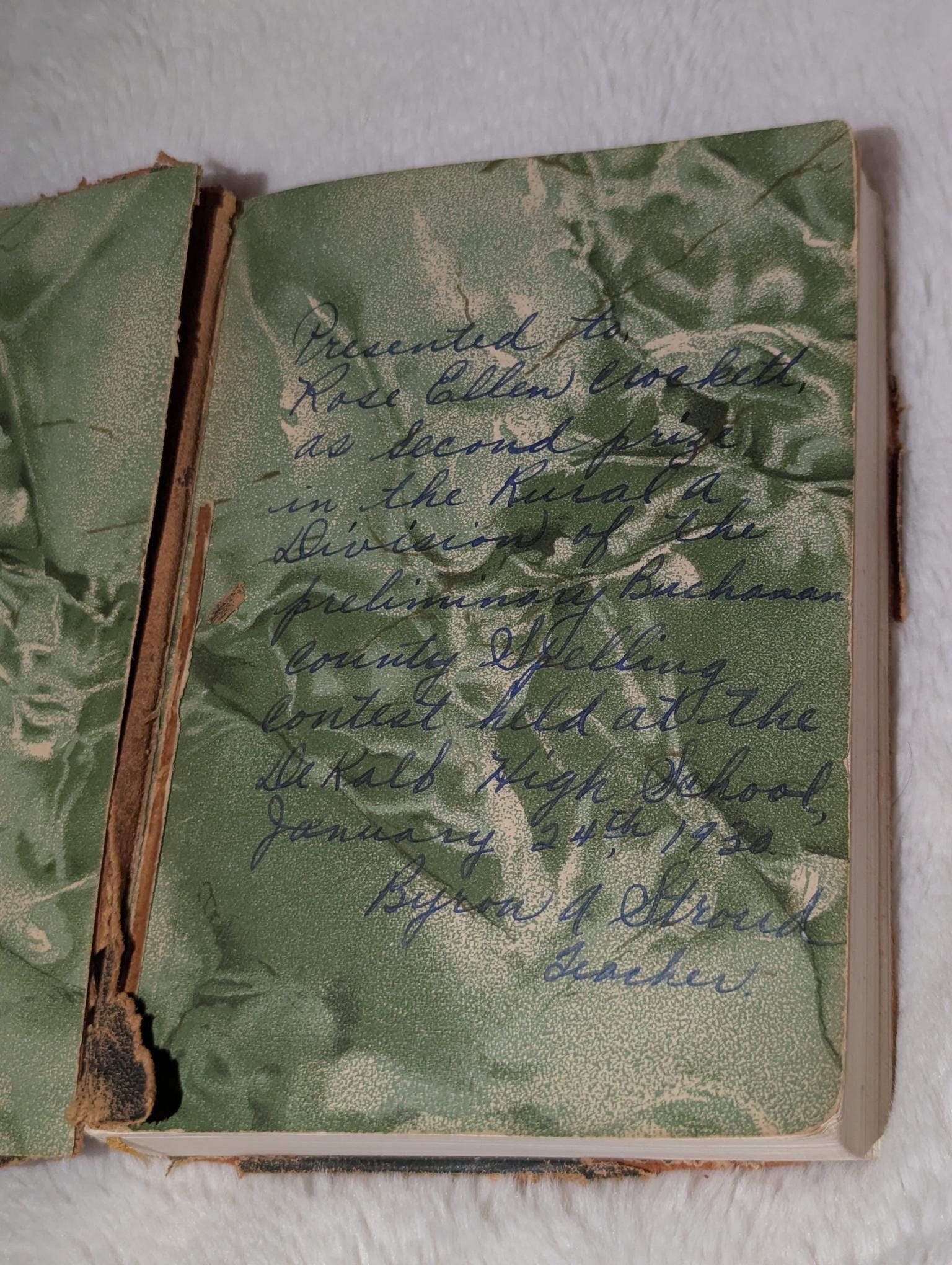
On January 24th, 1930, fifteen year-old Rosa Ellen Crockett placed second in the Buchanan County Rural Division A spelling contest, held at DeKalb High School in Missouri. For her achievement, Byron Albert Stroud presented her with a soft-leather-bound copy of Silas Marner by George Eliot. Stroud was a well-known local teacher who had unsuccessfully run for Superintendent of Schools in 1927 and who would end up detained and jailed, but never convicted over bad cheques in the late 30s, notably a five dollar cheque given to Townsend Grocery. These were difficult times.
In a newspaper clipping reporting on the contest, most likely from the St. Joseph News-Press, and which I found nestled between pages 158 and 159 of the book, we learn that Rosa’s younger sister Minnie placed third in B Division. We also learn that as a second place finisher in her category, Rosa advanced to “represent DeKalk at the county meet in St. Joe, Feb. 8,” referring to St. Joseph, still today the Buchanan County seat. A Florence Crockett placed fourth in the same category as Rosa, but it isn’t clear whether they are related.
The book itself was published in 1922 by the New York branch of Thomas Nelson and Sons, and printed in the UK by William Blackwood. That same year, Associated Exhibitors releases Frank P. Donovan’s film adaptation of the novel, starring Crauford Kent and Marguerite Courtot. Perhaps the edition is an early form of movie tie-in. Perhaps it isn’t.
Both Thomas Nelson and William Blackwood companies were founded in Edinburgh, in 1798 and 1804 respectively, and William Blackwood had published the first edition of the novel, along with those of several George Eliot works in the 1860s.
In May 1930, a few months before the spelling contest, Rosa is listed in the St. Joseph Gazette, the other local paper, as one of the graduates of the rural schools to have achieved an average of ninety percent or better. She is listed as graduating from Franklin School, the former Ward Three School, re-opened and renamed in 1867, after being closed during the Civil War.
After graduating from DeKalb High School, Rosa attended Chillicothe Business College, also in DeKalb. Not much further information is available about her from public sources, other than that she lived in Kansas City in the fifties and sixties.
Her family was originally from Sharpsburg, Kentucky, where she and her older siblings were born, and whose population has never been much above five hundred since its founding around 1780. It currently stands just above three hundred. Her parents moved to Buchanan County, Missouri, when she was a girl, and her younger siblings were born there.
Her father, Robert Lee Crockett, who sometimes went by Ira, was a tobacco farmer. His younger brother Charlie lived with the family and worked on the farm around the time Rosa was born. When she was two years old, her uncle Charlie went off to France. Private Charlie A. Crockett is buried in Plot C, Row 45, Grave 8, at Romagne-sous-Montfaucon, in Lorraine.
Uncle Charlie was in K Company (Supply) in the 139th Infantry, 35th Division, made up mostly of Missouri boys. After training stateside in late 1917, the 139th was in Le Mesnil Reaume, near Dieppe in Normandy, by May 21st, 1918.
The Americans were concentrating forces for the upcoming Meuse-Argonne offensive, and on June 12th, Charlie Crockett and his unit reached the front line at Moosch, near Mulhouse. On that day, they suffer their first casualty, Private Warren L. Day, electrocuted at 5:10 AM, possibly while setting up camp.
On September 26th, the big offensive that will end all wars kicks off. The allies are on the move all along the Western Front. The 139th advances from their jumping off point at Beauchamps Farm to Aubreville at 4:30 AM. The unit history says they’re in battle starting at 5 AM. Rosa’s uncle Charlie never gets to see the end of that first day of the Meuse-Argonne offensive, much less the end of the war. Or the end of all wars, for that matter.
There will be other tragedies in Rosa’s life.
In 1930, when Rosa earns her copy of Silas Marner, the Sprake family lives a few farms over. They have a twelve year old son named Donald Hubert. Rosa’s sister Minnie is ten. By 1940, twenty year-old Minnie Crockett has married twenty-two year-old neighbour Hubert Sprake.
By then, all the Crockett kids are off the farm except the youngest son, Charlie, born during the war and named after his uncle who never came back. He lives with his parents, along with his young bride and their newborn.
After DeKalb High School, Minnie, who had also placed well in the spelling competition, attends Maryville Teaching College, which eventually becomes Northwest Missouri State University. She teaches in one room schools in the area. She is a prominent figure of the regional 4H movement. Hubert deals in hogs. By all accounts, they have a normal rural life.
In 1968, Hubert and Minnie are involved in a car accident on County Road 5, near St. Joseph, the County seat where Rosa had represented Rural Division A in the spelling contest, thirty-eight years earlier. After a near miss, their car tumbles into a ditch. Their youngest daughter, twelve years old and Rosa’s niece, is killed. Their two other daughters are already married and out of the house. Their youngest was perhaps a surprise, born when Minnie was thirty-six.
Hubert and Rosa sue the other driver involved, an acquaintance. “I have knowed of him,” testifies Hubert when asked by opposing counsel. They lose on appeal, and no damages are awarded. The circumstances of the crash were unclear, and the other man stopped, even giving the young girl first aid, notes the judge in the case. Regardless of the outcome, there would have been no winners in that trial.
It’s only two years later, in 1970, that Rosa moves from Kansas City to Phoenix. Maybe she retires. She will be in Phoenix until she dies in 1997, still as Miss Rosa Ellen Crockett. She is buried back home, in Buchanan County, Missouri.
Her 1922 copy of Silas Marner, with its dedication from Byron A. Stroud and its newspaper clipping about Rosa and her sister Minnie, sits on my shelf.